Is Your Definition of Success Killing Your Team's Motivation?
What Is Success, Really?
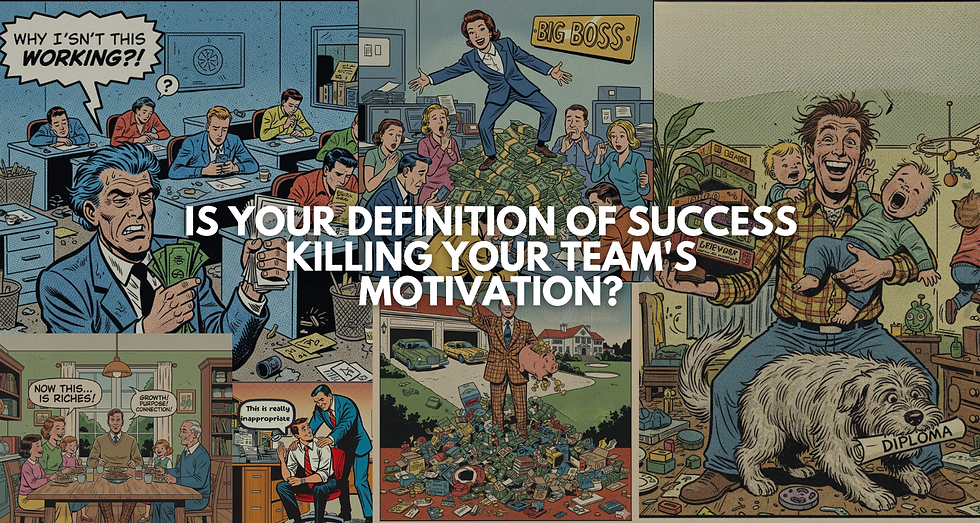
Call it my naivety, but for a long time, I defined success around money and things. How big was your house, paycheck, and 401k? What cars did you have, and how big was your garage to hold them?
As I settled into my career and life, my perspective started to shift. It wasn’t so much about the possessions anymore; it became more about growing and raising a family.
Now that I’m in the thick of that and a bit older (hooray middle age), my definition leans more towards finding fulfillment in life outside of capitalism and work. At least, that’s my current definition, and it will probably change again.
Talking to others about this, I’ve realized that success means very different things to different people. It feels like it should have a single definition, but it’s deeply personal (so much so that it’s almost akin to discussing politics or religion with some people). Which raises a leadership challenge: if success means different things for different people, how do you motivate a team?
Money only goes so far
There’s no denying that money matters; it’s an absolute necessity in the world we live in. It covers bills, provides health coverage (at least for us in the U.S.), food, etc. It allows us to take time away from work and reduces stress. Study after study, however, shows the effect is limited.
Psychologists Daniel Kahneman and Angus Deaton found that happiness rises with income up to around $75,000 to $100k. Beyond that point, it starts to plateau. I’m sure this varies depending on many factors like cost of living, etc., but the point is that there is a limit. More zeros in a paycheck do not directly translate to more joy in day-to-day life.
This isn’t new information; Maslow’s hierarchy of needs explains it pretty clearly: once financial and safety needs are met, higher motivators take over like belonging, esteem, and purpose.
For leadership, this means raises and bonuses for your team are only one part of the story. They are useful signals, but not lasting fuel.
Titles don't equal success
Another common trap is assuming that titles define success, and here I am to rain all over that parade, too. A fancy title may look good on LinkedIn, but it isn’t what keeps people motivated or loyal. People don’t follow job titles or stick with companies because they were given a better one. They follow leaders.
Promotions are often treated as the ‘next step’ reward, but not everyone wants them. Some people are happiest staying in their role, doing work they enjoy, and avoiding the added responsibilities that come with a title change
The leaders who make the biggest impact aren’t always the loudest or most visible. They’re the ones who listen, guide, and consistently create an environment where people feel supported and empowered.
Promotions and titles might signal success on the surface, but they’re not what actually drive people long term. Real leadership shows up in the daily actions they take; the way you build trust, listen, and make your people feel like they matter.
What people actually want
Typically, money isn’t the lever that keeps people going. Often it’s the chance to actually own their work, get better at what they do, and feel like their efforts matter and are making a meaningful difference.
Daniel Pink calls these autonomy, mastery, and purpose in his book Drive. Those three words line up with what I’ve seen over and over:
When someone has real control over their work, they’re more invested in it.
When they’re challenged just enough to grow, they find momentum.
When they can connect the dots between their work and a bigger outcome, the work feels worth it.
It isn’t just theory. The Harvard Study of Adult Development, which has tracked people’s lives for more than 80 years, points to the same thing: long-term well-being depends more on meaningful relationships and purpose than on wealth or fame.
Leading with this in mind
I have seen people and entire teams blow the eff up when raises weren’t what they expected. I’ve also seen them put the pedal to the metal when they were trusted with more responsibility, felt like their opinions were heard and helped shape decisions, and were given room to fail, learn, and improve.
Money is a reminder that someone is performing well and raises act as a measuring stick. When they feel like the raise isn’t aligned with their work, it’s a slap in the face. Sidenote: It also usually means that their leaders aren’t communicating challenges and expectations well enough.
Promotions and raises are, at best, temporary motivators. Real motivation sticks when people feel seen, heard, challenged, and valued in ways that align with their definition of success.
So, What Is Success?
Success looks different for everyone: a paycheck, a family dinner, a project you’re proud of, or in some cases, not working at all.
If you are in a position of leadership, your job is to find what motivates your people, and build that into your culture, style, and company values.
The next time you want to say, “They should do it because it’s what they get paid to do”, ask yourself... What do I know about my team that would actually help motivate them to get us across the finish line?
References that might be worth exploring:


